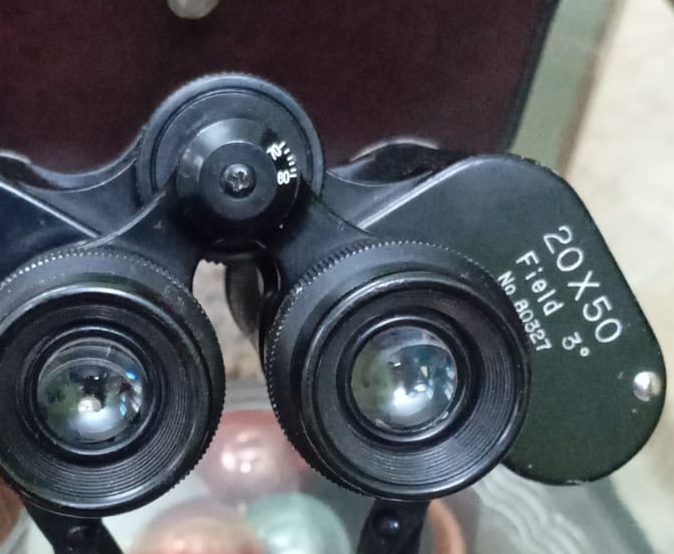
Which Lenses Are Used in Binoculars? Convex lenses are used in binoculars and telescopes to enlarge objects and make them look closer, but they distort and blur images instead of precisely transmitting light. Concave lenses are therefore included by telescope and binocular makers in or before the eyepieces to aid in sharpening pictures for the viewer.
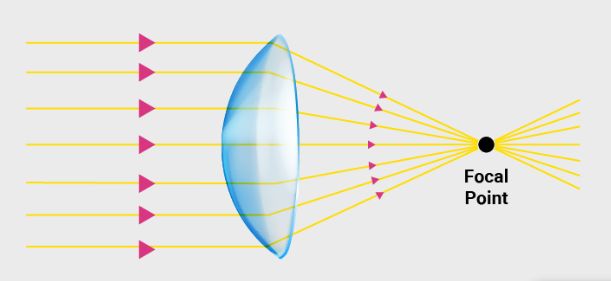
An optical lens is generally made up of two spherical surfaces. If those surfaces are bent outwards, the lens is called a biconvex lens or simply a convex lens. These types of lenses can converge a beam of light coming from outside and focus it to a point on the other side. This point is known as the focus and the distance between the centre of the lens to the focus is called the focal length of the convex lens.
Uses of Convex Lenses
Cameras
Some cameras use convex lenses to focus and magnify images. You can change the camera’s magnification by repositioning these lenses. By doing so, you can fine-tune the magnification by shifting the focal point. You can also find convex lenses being used in webcams, video cameras, and others.
Peepholes
Doors with peepholes allow anyone to view what is going on on the other side without opening the door. For additional safety, these holes can be tucked away in undisclosed locations.
Although the hole is relatively tiny, the image on the opposite side is enlarged because of the convex lens put inside. With this lens, the viewer can easily see who or what is on the other side of the door by looking through the peephole.
Microscopes
An optical microscope allows you to study microscopic features such as those found on microfibers, bacteria, and others. The microscope uses a convex lens to enlarge the image. It works by using a set of three lenses. You can also find compound microscopes (with more lenses) that magnify microbes even more dramatically.
Eyeglasses
When your eye’s lens can’t concentrate light where it needs to be, it will be hard to see clearly. For example, people with hyperopia (far-sightedness) find it hard to see nearby objects well but have no trouble seeing distant objects.
This is usually caused by the ciliary muscles’ failure to change the eye lens’s focal length properly. In a case like this, the objects’ rays are converged on a spot behind the retina. Hence, the rays of light need to be focused in a way that they converge on the retina, and this is where convex lenses come in. You can fix far-sightedness by placing convex lenses before your eyes (wearing glasses).
Projectors
A projector is an optical device with the capability of displaying images or films on massive displays. An essential principle of a projector’s operation is the enlargement of a moving image or video onto film.
In this case, the lens produces an enlarged and flipped image. So, to fix the flipped image, the film is always uploaded upside down.
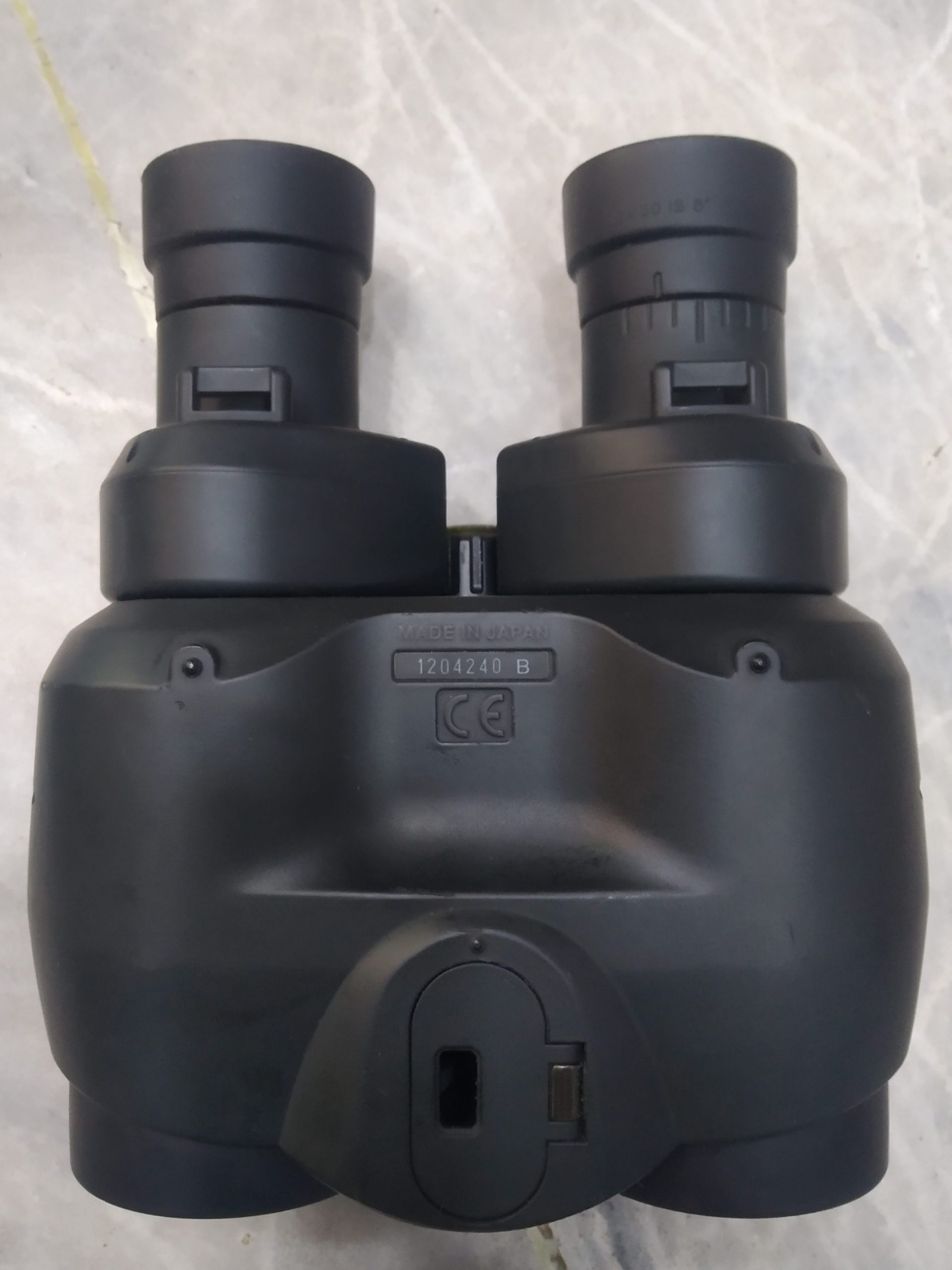
Canon 12×50 Binocular for Bird watching
Refracting Telescopes
Telescopes work best for seeing objects incredibly far away, such as planets. You can find two types of telescopes – one made with mirrors (reflecting telescope) and the other with convex lenses (refracting telescope).
A refracting telescope contains two convex lenses. One lens combines all the light rays while the second zooms in on the image.
Magnifying Glass
A magnifying glass works by focusing all the light entering the lens on one spot, which is known as the focal point. The item is magnified when the space between the lens and the object is smaller than the focal length.