How Can We Use Binoculars for plane watching. Here’s a comprehensive guide on how to use binoculars effectively for this hobby.
1. Choosing the Right Binoculars
This is the most critical step. Key specifications to look for:
- Magnification (Power):8x to 10x is ideal.
- 8x: Wider field of view, easier to track and find planes, steadier image.
- 10x: More detail (like seeing liveries, markings), but shakier without support. Avoid anything above 12x for handheld use.
- Objective Lens Diameter:42mm is the sweet spot (e.g., 8×42, 10×42).
- This provides a great balance of light gathering for daytime/dawn/dusk and a manageable size/weight.
- Lens Coatings: Look for fully multi-coated lenses. They maximize light transmission, providing brighter, sharper, higher-contrast images—crucial for seeing details against a bright sky.
- Close Focus: Not a priority for planes, but a decent close focus (<10 ft) is useful for looking at charts or equipment.
- Water Resistance & Ruggedness: Since you’ll be outdoors, Fog-proof/Waterproof (nitrogen purged) is highly recommended.
- Type: Roof prism binoculars are generally more compact and ergonomic than porro prisms for this use.
Recommended Starter Configuration: An 8×42 or 10×42 waterproof, fully multi-coated roof prism binocular.
2. Essential Techniques for Effective Use
- Master the Focus:
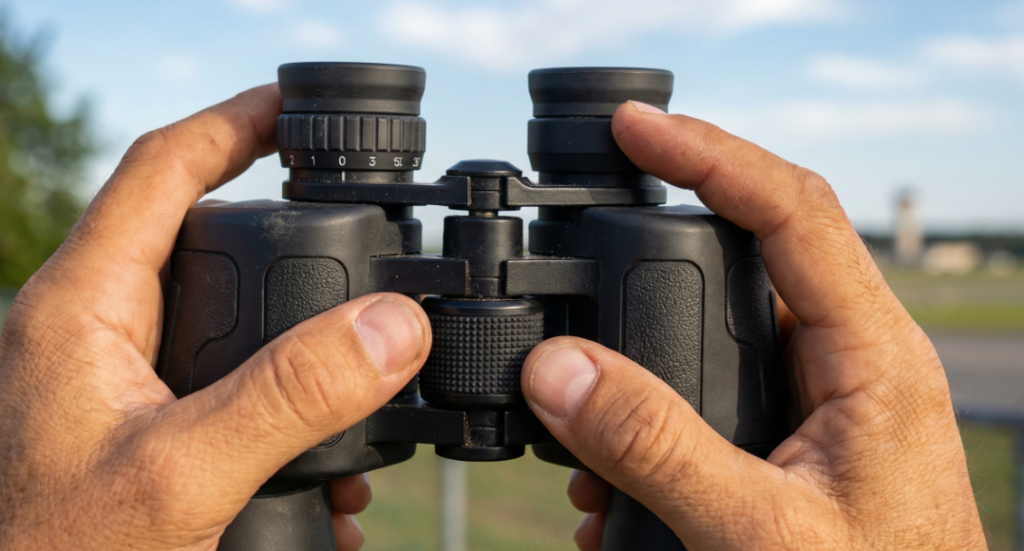
- Most have a central focus wheel and a diopter adjustment (usually on the right eyepiece). Adjust the diopter first for your dominant eye (look at a distant object, cover the right lens, focus with the center wheel for the left eye. Then cover the left lens and use the diopter ring for the right eye). Once set, you’ll only need the center wheel.
- Finding the Plane (Acquisition):
- Never try to find a plane through the binoculars first. Always locate it with your naked eye. Once you have it, keep your eyes on it and slowly bring the binoculars up to your eyes. With practice, the plane will be centered in your view.
- Holding Steady:
- Hold the barrels, not the eyepieces. Rest your elbows on your chest, a railing, car roof, or wall. Leaning against a solid object is the best handheld trick. For high magnification (10x+), consider a monopod for incredible stability without the bulk of a tripod.
- Tracking Movement:
- Practice smooth panning. Move your whole torso, not just your arms. A wide field of view (lower magnification like 8x) makes this much easier.
3. Where and When to Go
- Locations:
- Airport Perimeter: Near runway ends (fence lines in designated spotting areas). Check for official “planespotting” locations on airport websites.
- Observation Decks: Some airports have public viewing terraces.
- Parking Garages: Often provide an elevated view (ensure it’s legal and safe).
- Under Flight Paths: In parks or open fields for approaching/departing traffic.
- Time of Day:
- Golden Hour (early morning/late afternoon) provides beautiful lighting and long shadows that accentuate an aircraft’s contours.
- Avoid midday when the sun is directly overhead and light is harshest, unless you’re in a shaded position.
- Sun Position: Always keep the sun behind you. Looking towards the sun will result in glare, washed-out images, and potential eye damage.
4. What to Look For (The Fun Part!)
Use your binoculars to see details you’d miss with the naked eye:
- Liveries & Markings: Airline logos, special paint schemes, registration numbers (tail numbers).
- Aircraft Type: Engine types (turbofan, turboprop), number of engines, wing & tail shape.
- Details: Landing gear, flap settings, vortex generators, airline titles.
- Activity: Ground operations, tug movements, loading.
5. Gear & Etiquette
- Essential Companion Gear:
- Aviation Radio/Scanner: Lets you listen to ATC to know what’s coming.
- App/Book: A flight tracking app (FlightRadar24, ADS-B Exchange) and a aircraft recognition guide.
- Notebook & Pen: For logging registrations, types, and times.
- Spotting Etiquette & Safety:
- Never point binoculars or a camera at security personnel, police, or sensitive airport infrastructure.
- Obey all signs and stay in public areas. Trespassing is a serious offense.
- Be mindful of your surroundings, especially near roads.
Quick Comparison: 8×42 vs 10×42
| Feature | 8×42 Binoculars | 10×42 Binoculars |
|---|---|---|
| Best For | Beginners, tracking movement | Detail, stable conditions |
| Field of View | Wider – Easier to find/follow planes | Narrower – Target acquisition is harder |
| Stability | More stable – Hand shake is less apparent | Less stable – Shakiness more obvious |
| Detail | Good for overall view & identification | Superior for reading small markings |
| Light | Identical light gathering (42mm lens) | Identical light gathering (42mm lens) |
Final Pro Tip: Start with your binoculars without any straps around your neck. Hold them firmly and practice bringing them up to your eyes quickly and smoothly. Once comfortable, add the strap for safety.
Why leupold binoculars are best for Hunting
Another few tips how to Use Binoculars for Plane Watching
1. Choose the Right Binoculars
For plane spotting, the best binoculars are:
- 10×50 (most common)
- 12×50 (better zoom, but needs steady hands)
- 15×70 (very powerful, tripod recommended)
10×50 is perfect for beginners.
2. Find a Good Location
Choose a place where:
- The sky is clear and open
- You can see the runway or flight path
- There’s less light pollution (good for night spotting)
Airports often have safe public viewing areas.
3. Learn to Spot with Your Eyes First
Before lifting binoculars:
- Look at the plane with your eyes.
- Track the direction it’s moving.
- Then bring binoculars up to your eyes without losing the plane.
This helps you find the plane faster.
4. How to Hold & Use Binoculars
- Hold binoculars steady with both hands.
- Keep your elbows close to your body for stability.
- Adjust the focus wheel until the plane looks sharp and clear.
- Use the diopter adjustment (usually right eyepiece) to match your eyes.
5. Tracking Moving Planes
- Start watching the plane when it’s far away or coming toward you.
- Move slowly, following its path.
- Don’t jerk your hands; smooth movements give a clear view.
- If you lose the plane, look with your eyes first, then use binoculars again.
6. Use a Tripod for More Stability
If your binoculars are 12× or 15× zoom:
- Use a tripod or monopod for steady viewing.
- This helps when planes are high or moving fast.
7. Best Time to Plane Watch
- Morning (clear air, good light)
- Evening golden hour (beautiful lighting)
- Night spotting with airport lights (useful for identifying aircraft lights)
8. Learn Aircraft Types
While watching through binoculars, you can identify:
- Airline logo
- Tail design
- Engine count
- Wing shape
- Belly logo (at airports)
Apps like Flightradar24 or RadarBox help track which plane you’re seeing.
9. Safety Tips
- Never point binoculars directly at the sun.
- Stay in safe public areas around airports.
- Avoid restricted zones.